15 October 2013

Captain Phillips


It seems the season is upon us now where movies really want to be awarded things. Sometimes this means we get really great stuff, like Gravity. Other times it means we get good-but-not-spectacular-and-therefore-kinda-deceiving stuff like Captain Phillips. As a story it is one of the great maritime episodes of recent history. As a movie, it is competent but not really special, combining a solid performance by Tom Hanks with an all right rest of it overall.

Captain Phillips' titular character is played by Hanks. He is a commercial freighter captain shipping cargo around the African horn. This of course goes wrong when a band of Somali pirates boards their ship.

The movie has two main problems that are sort of the same problem: this is a story that we know the ending of specifically, and a genre we are overly familiar with generally. Therefore, most of the work put into making it suspenseful is kind of wasted. Director Paul Greengrass is good at this (he gave us two Bourne movies) but it doesn't have the effect here. But even if you don't know the specifics of the story, you are acquainted with the rescue movie genre and its conventions. The movie goes willingly along with all of them, and results in a lot of ill-spent energy.

There is an attempt to get around all this, to a certain extent, but I don't think it quite makes it. We get to know the four pirates pretty well, and they seem to be our outlet into something a little different. Their leader especially has an interesting relationship with Phillips, and there is an attempt to make something of this. They are both captains, but they differ radically with how they act in relation to their crew. This is kind of neat, but ultimately doesn't pan out to much. 

The movie, notwithstanding my comments above, is pretty watchable. There are even some tense moments even though we pretty much know the outcome, so chalk that up to Greengrass' skill. The movie's best part by a long stretch is its last fifteen minutes or so. As it wraps up there are some interesting little threads of moral ambiguity--nothing inflammatory but enough to remind that there are multiple sides to every story. There are also some powerful moments showing the trauma experienced by some characters that really bring the movie down to the level of real-life, rejecting any action-movie similarities there might have been.

So I say that Captain Phillips is good but not necessarily noteworthy. In other terms, it is more worthwhile as a weekend rental than as a show with paid admission. As always let me know what you thought about it.

Captain Phillips features Tom Hanks, Barkhad Abdi, Barkhad Abdirahman, and Faysal Ahmed, and is rated PG-13 for some violence.

Writer: Billy Ray
Director: Paul Greengrass

08 October 2013

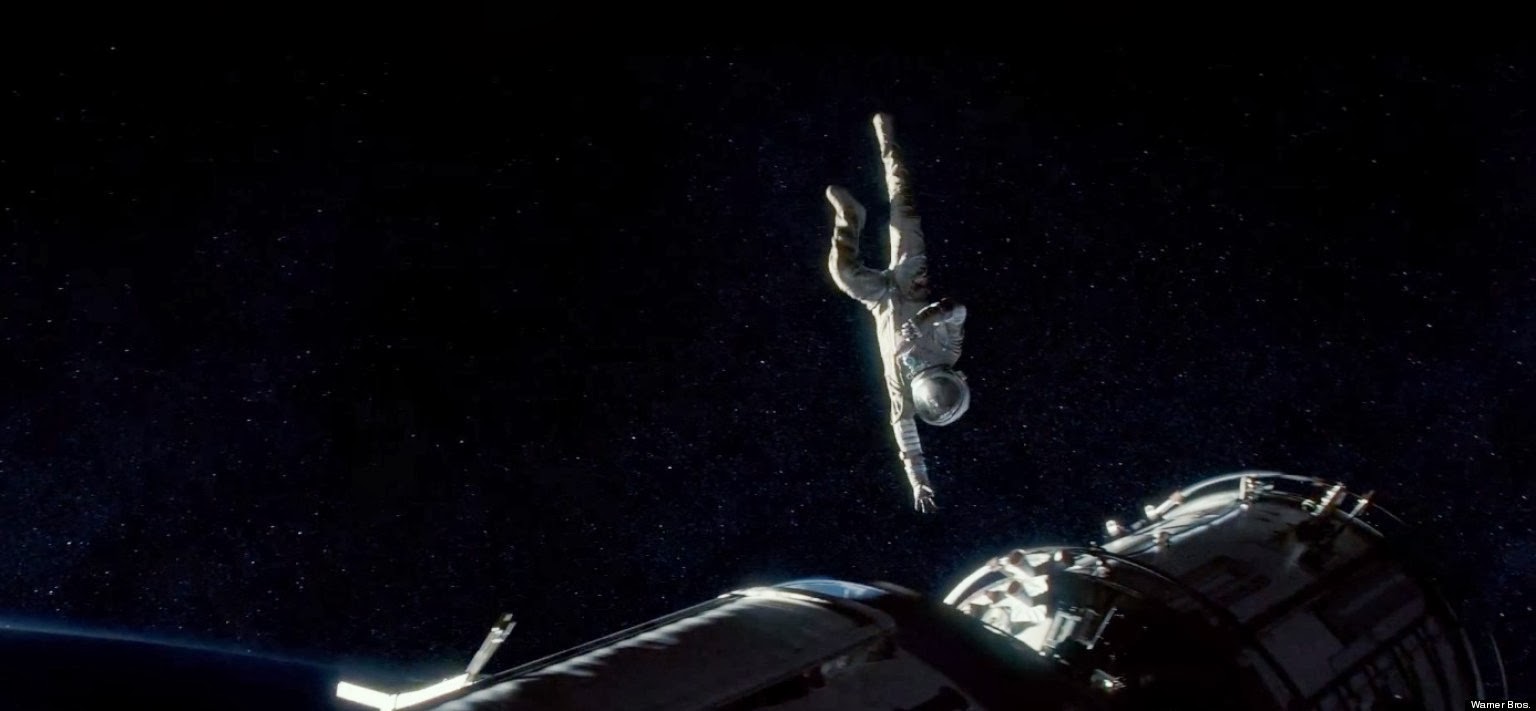
Gravity


I have a new favorite movie this year, and it is called Gravity. The word "favorite" implies that the other movies I liked are inferior to it, or that I don't like them any more. That isn't true, really. Movies like The Kings of Summer and Pacific Rim still stand out, but Gravity is on a different plane. It is overwhelming and beautiful, terrifying and intimate, a consummately fine film.

The movie is about Ryan Stone (Sandra Bullock), a scientist in space for the first time working to install an experimental device on a satellite. With her is Matt Kowalski (George Clooney), who is on his last mission. Together they survive a terrible accident that leaves them floating in space, hundreds of miles above the earth.

Part of what I love about the movie is the entirely realized vision of director Alfonso Cuarón. It makes no concessions in its portrayal of the story, and results in an entirely unique viewing experience. The movie opens with a seemingly continual shot that lasts for minutes, immediately immersing us in his world. His distinctive use of the camera throughout enforces the illusion of being in space with the characters, making it one of the most beautiful pieces of cinematography I've experienced. This adds a certain level of both intimacy and terror, since in large part we are on stage with the actors. The movie feels like it is encircling the audience. Perhaps a better analogy is that the audience is the roaming camera, finding action as it happens. It is really one-of-a-kind.

The visual effects are also a key element to the movie's success, and are actually more essential to the "camerawork" than the actual camera. The sound design is also incredible. All of the technical aspects working seamlessly together allow the artistic and thematic elements to really shine. That is the other part of what I loved about it: it isn't simply the disaster/survival movie it easily could have been. It certainly has those elements, but it adds up to more. It almost seems like a combination of Castaway and 2001: A Space Odyssey. The movie is consciously philosophical, even spiritual. It deals powerfully with concepts of mortality and rebirth, of guilt and forgiveness. Indeed, it is almost a grand parable for the entire cycle of life, ironically told where life cannot possibly exist on its own.

This all plays out with essentially two characters. This may be one of the film's biggest risks, but it is certainly one of its greatest payoffs. Sandra Bullock especially carries the emotional weight of the movie, and she does so quite well. This was pleasing to me, since she has always been inexplicably irritating to me in movies. She was my only qualm going in, but proved me wrong as soon as it got going. She brings a down-to-earth (excuse the pun) sensibility to it that brings all of us non-astronauts along for the experience. Her part is as crucial to the film as anything else.

And so I say without reservation that Gravity is worth it, all the way. It is certainly tense enough to merit watching merely for thrills, but its soulful depiction of humanity and life makes it special. I saw it in regular old 2D, but I think its 3D treatment would be worthwhile as well.

Gravity features Sandra Bullock and George Clooney, and is rated PG-13 for some scary things and understandable swears.

Writers: Alfonso Cuarón & Jonás Cuarón
Director: Alfonso Cuarón


24 September 2013

Prisoners


This is typically the time of year when studios are all out of big-budget blockbusters to parade around, but aren't quite ready to cast out their award bait either. The result is a cinematically sterile autumn every year, which is a little sad since this is my favorite time of year. To my surprise, Prisoners proved a welcome break from the nothing interesting going on.

The movie is about two families whose daughters mysteriously disappear. Time goes by and the police investigation looks increasingly unpromising, so one father (Jackman) decides to take matters into his own hands and track down the person he feels is responsible.

This movie is a nice little chiller put on a slow burn. Everything is carefully measured and restrained. This, I think, is its biggest strength. Without it, the movie would have been merely a variation on Taken, only without the fun of having no shame. The movie is relentlessly rainy, and I think cinematographer Roger Deakins goes to town with it. The whole thing looks beautiful (but really, like rainy shots in autumn ever don't) and immediately has a constant mood. This has everything to do with the power of the images created, and is commendable.

The plot, for the most part, matches the control exhibited in the movie's craft. It is all intentional, from its formulaic setup to its almost immediate turnaround. It keeps twisting and descending into this macabre little maze you want to find your way out of. It is certainly enveloping and immersive.

That said, I think the major weakness of the movie was the characters. The acting is good, even at times commendable, but the material the actors were given wasn't completely realized. It feels like writer Aaron Guzikowski got started on a lot of cool things but didn't finish them in time. For as well as everything comes off, having characters as depthless as these was a little disappointing.

By the end, though, it turns out to be pretty satisfying. There is enough thematic material and plot turns going on to outweigh the underbaked character or two. At any rate it beats the pants off of anything else you will find out there this week. Its subtlety of storytelling is something that is hard to find these days, and makes it at least a pretty unique, if not a special, movie experience.

Prisoners features Hugh Jackman, Jake Gyllenhaal, Terrence Howard, Viola Davis, Maria Bello, Paul Dano and Melissa Leo, and is rated R for swears but not as much violence as you might expect.

Writer: Aaron Guzikowski
Director: Denis Villeneuve

16 September 2013

"The Spectacular Now" & "The Way, Way Back"

For the sake of something different, I'll be including two movies together in the same post. This isn't necessarily because they are similar; it has more to do with how little time has passed between my seeing them. They are The Spectacular Now and The Way, Way Back. Both are fine movies, and good ways to start off the new school year.


First is The Spectacular Now. It is the story of Sutter, an hard-living high school senior recovering from a brutal breakup. He meets Aimee, a quiet girl he falls for in spite of himself. Their complicated relationship and differing perspectives on life end up teaching them both some important lessons.

Of the two, I think this is the better movie. Despite this synopsis, the movie doesn't really adhere to all of the hallowed tenets of the coming-of-age genre you might think it to. For starters, it is considerably more adult than the typical offering, leading me to think that it isn't necessarily about teenagers. It is about their families as well, and the world they end up coming into. Director James Ponsoldt has a very delicate touch throughout--he balances teenage romance with darker themes in a beautifully intimate palette.

The whole movie, in fact, feels like an intimate close-up. The writing and its interpretation is incredibly realistic (almost to the point of irritation, I must confess), and much of it happens in these wonderfully long takes. We aren't watching a movie, we are watching a relationship of people we know, and it is beautifully executed. By the end, everybody is not the same person as at the beginning, but it is no concrete resolution. Like any change of perspective, it is raw and untested, but full of hope.


The more general audience-friendly of the two is The Way, Way Back, which tells of The Most Awkward Summer Ever. Duncan is spending the summer with his mom and would-be step dad Trent (Steve Carell) at an out-of-the-way resort town. He doesn't get along with Trent, other growups, girls, and is trying to make his way around in a world full of dysfunction and confusion.

The Way, Way Back feels very familiar in a lot of ways. And, if left in the hands of lesser filmmakers would be nothing more than a Disney Channel Friday night movie. But it makes its mark in two ways. First, the adult characters are very well-realized. They are not the caricatures that so often plague movies like this; they are emotive and confused and as emotionally bruised as much as anybody else. Of note are the two men in Duncan's life, Trent and Owen (Sam Rockwell). Theirs are the strongest performances, and the most meaningful to the movie.

The movie is certainly enjoyable, and lighter fare than Spectacular. It is consistently funny, though it is also empowering and honest as well. That is its other strength: where convention demands that everything wrap up with misunderstandings now understood and everything happening for the best, The Way, Way Back offers something a little more true. Love is only accomplished when understanding is not a pre-requisite, and you need to choose to go there.

The Spectacular Now features Miles Teller and Shailene Woodley, and is rated R for swears and teenagers doing lots of things they shouldn't.

The Way, Way Back features Steve Carell, Toni Collette, Sam Rockwell, Maya Rudolph, and Liam James, and is rated PG-13 for some swears.

04 September 2013

Special #9: You Can't Take It With You


1938 saw Frank Capra win his second Best Picture in four years with the screwball comedy You Can't Take It With You. It is a light-hearted venture certainly well-suited for Depression-weary America, but it doesn't carry over as well as some of his other work.

The movie is about two families: the rich, stuck-up Kirby's, and the humble and eccentric Sycamore's. Tony, the Kirby heir, (Stewart) falls in love with young Alice Sycamore (Arthur), which results in a culture clash between the two families.

The film fits well in Capra's brand. It is very strongly family-centric, and appeals to that class of 20th Century American eager to live out the clean, moral, American dream. Organizations like big business are criminalized, while activities such as making fireworks in your basement are seen as quaint. Those things certainly would have appealed to a country still looking for a way out of the Great Depression. Most of the film's humor comes from exploiting the "otherness" of the wealthy -- they are comically detached from humanity and out-of-touch with real life. Capra takes up this theme again in It's A Wonderful Life, but for dramatic rather than comedic purposes.

Despite this, I felt that the movie didn't translate very strongly compared with some of his other movies. There are lots of Capra-esque cultural embellishments (a group of rag-tag kids teaches Tony and Jane a new dance in the park, for example) that add to the stylized vision of America he adopts, but that also take away somewhat from the overall film experience. I felt like I had to try harder to be a part of it than other movies, even poor ones, from this time period.

That's not to say I didn't enjoy it. Stewart and Arthur are particularly enjoyable together. The movie's best moments are with them, when it at its ease and isn't trying to moralize. But overall I feel that this is a case of enormous-but-waning popularity defining a movie, rather than its inherent quality.

You Can't Take It With You features Jimmy Stuart, Jean Arthur, Lionel Barrymore, and Edward Arnold, and is not rated.