11 November 2015

Spectre

Movies in the James Bond genre are an interesting breed. And don't get me wrong, they are their own genre, one that has managed to exist for over 50 years now. I recently rewatched the entire collection, and something occurred to me: most of them are not all that good. Plot-wise, they are all basically the same. There are notable characters or sets or music, but they are very often essentially the same movie. But, if you are a fan there is no real problem with this. You watch them to experience your inner playboy English gentleman.

Enter Spectre. It is a movie which does little to subvert expectations or plumb new depth in the way that the series has attempted since Daniel Craig's ascension to the role. Some have argued that it is the worst of his entries for that reason, especially since it seems to claim to do otherwise. But I am not so sure. It may well turn out to be that, but I am hopeful that time will prove otherwise.

Let us now speak frankly of the plot, or at least a part of it. I am at once happy to see the return of Blofeld, and a little disappointed. I am disappointed because the filmmakers pulled a Star Trek Into Darkness on us by pretending he wasn't Blofeld until it was time for a dramatic reveal. The trouble with this gimmick is that it only works on fans of the movies, in this case, movies that are now more than 40 years old. The change of character name (as with Into Darkness) means nothing unless you are. So it is an unfortunate, self-aware fanboy concession that adds only sentimental value.

But, I am happy because it now opens up wonderful possibilities for the future. The films have lasted so long in part because of their nondependence on each other for continuity. Each is (for the most part) its own separate episode. Blofeld is far and away the most iconic and sinister Bond villain, as well as the only recurring one. I also like how personally connected to Bond he now is. Now Spectre leaves me thinking that perhaps this pattern will be broken, and that the film will be something like the first of two parts. Which makes me feel mostly okay about the relative incompleteness of plot and emotional resonance with a 160-minute film.

I say mostly because Spectre, considered on its own, is fairly mundane. The action meets the series' high standard, but the emotional side of Bond explored of late is pretty muted. The plotting (as with them all) is a little silly at times, but the concern over surveillance and its misuse by desk jockeys feels at least timely, if a little unoriginal. I also tend to hate the kind of wait-til-next-time-for-the-real-story world building so many franchises are now guilty of, and one thinks that this film is that kind of link in the chain. It is enjoyable, manages something of a light heart, and is certainly better than anything else out this week at the multiplex.

But such it is to be a fan of a film series: quick to forgive so long as there will be more to come. As long as whatever comes doesn't include Sam Smith.

Spectre features Daniel Craig, Christoph Waltz, Léa Seydoux, Naomie Harris, and Ralph Fiennes, and is rated PG-13 for general Bonding throughout.

Written by John Logan, Neal Purvis, Robert Wade, and Jez Butterworth
Directed by Sam Mendes

02 October 2015

Octobooooo-er Special: Nosferatu

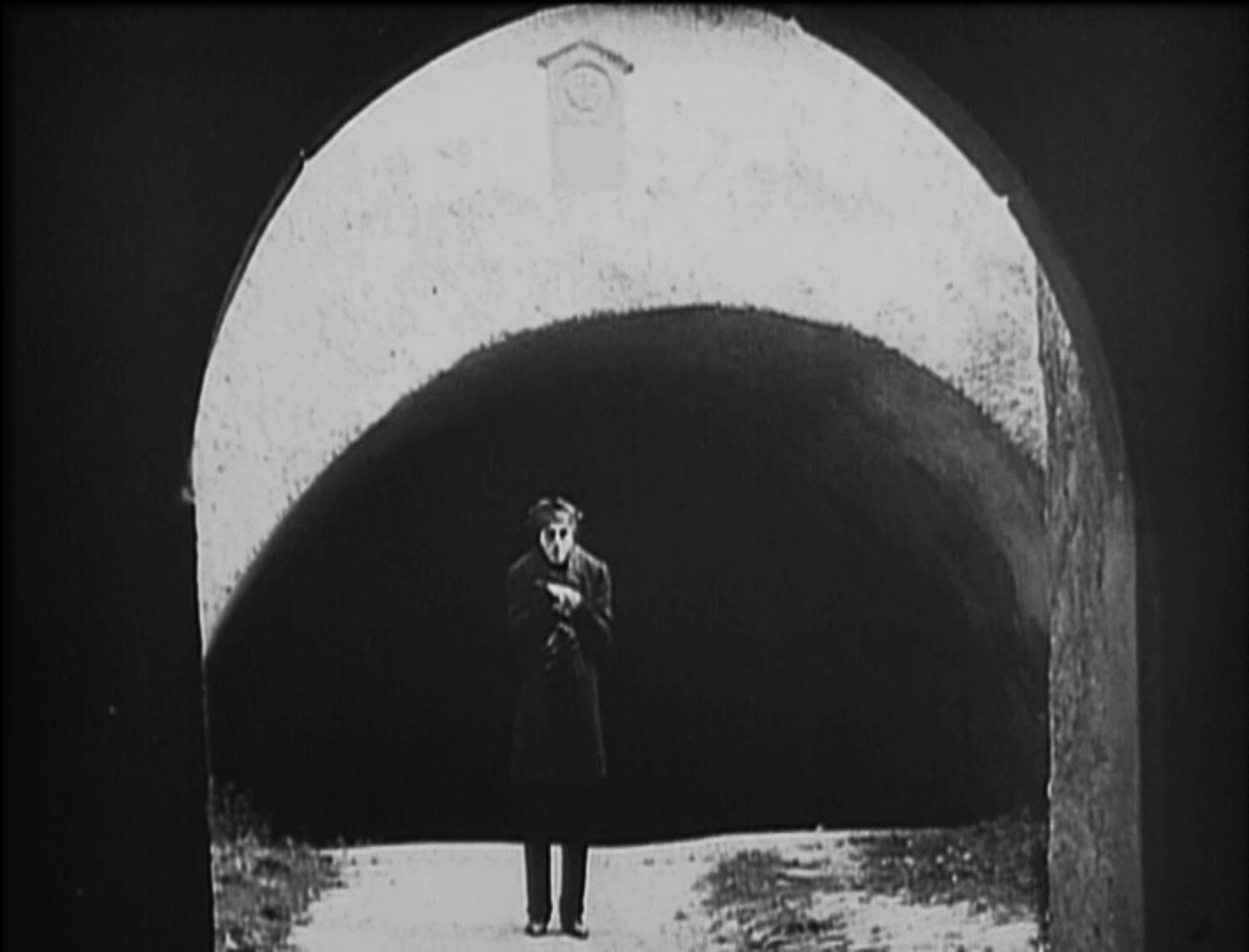
Max Schreck as the titular bloodsucker
We have now come to that most wonderful of seasons, the October season. And to celebrate, I am going to present a series concentrating on spinetingly-dingly films for your enjoyment. The first of these is one of the great achievements of the silent era, FW Murnau's Nosferatu: A Symphony of Horror.

Taken together with 1920's The Cabinet of Dr Caligari, Nosferatu (1922) forms the foundation upon which all horror cinema builds. (And indeed, the two pair excellently as a double feature.) Like Dr Caligari, it comes out of the German expressionist tradition. The film retells in an unauthorized, folklorey kind of way Bram Stoker's tale of Dracula, which I hope I don't have to summarize for you. 

The film's most striking feature is its iconic imagery. You have seen the shadow of Nosferatu's taloned hand reaching for his victim; his pale, pointy face in reverse silhouette against the dark. You know what he looks like as he rises from his coffin and as he moves up the stairs. These and other images from the film have been reproduced, parodied, and referenced to one degree or another in almost any horror film you have ever seen. Much more than its cousin Dr Caligari (which sets the par for striking imagery) Nosferatu has remained an essential element of our cultural subconscious. I think this is  in part due to the fact that, although undeniably expressionist, the film's real locations (instead of cubist, abstract sets) ground it in a kind of reality that the fever dream of Dr Caligari doesn't reach for. It feels just off-center instead of nearly hallucinogenic.

The other element that takes the film a step beyond Dr Caligari and maintains its amazing influence is its pioneering achievement in editing. Some of its best moments are when it intercuts between the vampire's ship and the separated lovers he threatens. These truncated pieces balance wonderfully with the long, methodical takes that dominate whenever Nosferatu is present to create an agonizingly fatal kind of mood. He is as inevitable as the tide, an ever-present theme in this silent symphony.

Lest I inadvertently plant expectations that won't be met, I should note that in establishing the genre, the film differs quite substantially from our modern horror sensibilities. In fact, I would say that it likely won't "scare" you like you're used to. There are no "jump" moments or even attempts at irony or mystery. What you will find instead is a slow, constant, fully-realized single image, which, as a film, you have as little control over as our heroes do their fate. You and they can both only watch, and hope for a good end.

I should also note that many versions of Nosferatu can be found for free on the internets, and that probably none of them are very good. Film scans used are often incomplete or of poor quality, and the music can either have nothing to do with the film or just be really bad. I recommend finding a proper DVD release, which are usually done by some manner of film preservation society. Their scans are as good as can be found, and the music is usually at least not bad. If you prefer, though, watching it with no music at all is especially ambiential and creepy if you are alone in your room at 11 at night and it is raining. Just saying.

So I say you really should see Nosferatu. It is certainly a great way to start off your October season, and is as foundational and influential to the horror genre as anything out there.

Nosferatu: A Symphony of Horror features Max Schreck, Gustov von Wangenheim, Alexander Granach, and Greta Schroeder, and is unrated, though appropriate for most audiences.

Written by Henrik Galeen
Directed by FW Murnau

Fan-made trailers, like full copies of this film found online, vary greatly in quality. I suggest watching this with the sound muted, because the music is beyond obnoxious. But it gives a glimpse of the images, as well as the color-tinted filmstock some restorations use.


21 September 2015

The Visit

Over the river and a through the weird, to Grandmother's house we go.
Well, I'm back (not that you were upset) just in time for fall. I won't hesitate in saying that the summer cinematic season was a little less than exciting for me, but there are a few I'm looking forward to starting now. The first of these, just in time for fall, is M. Night Shyamalan's The Visit. It is his most stylistically sincere film in many moons, although how you feel about it will depend on how much strange you like in your diet.

The film is about Becca and Tyler, tweenaged siblings who go for a week's family bonding with their estranged grandparents. Weird old people problems become gradually less shrug-offable as the week wears on as Becca sifts through the footage to help bring the family back together.

First, I'll address what you've probably heard, that this film is a refreshing return to form for Shyamalan. This is mostly incorrect. True, the film provides jumps and tension, and it also showcases his humor more than any of his work since probably Signs, and is not bad. However, the director's subtler (and more defining) stylistic hallmarks are not present. There is no carefully-meditated cinematography, no spiritual undertone, no introspective current. The film feels, more than anything else, like a stretching of creative arms after increasing studio oversight and critical derision, coupled with the producing talents of the people who brought you Insidious.

So let's talk about the film we have. I said it was stylistically sincere, and that style takes the form of a documentary shot by our protagonists. It is not "found-footage," but is only just barely more cinematic. The location is beautiful and the establishing shots wonderfully composed, but much of the action is composed of blurry, jittery footage that would likely not have made it into Becca's documentary. Not that it doesn't work. But even under the guise of "documentary style," it is a form that demands constant attention to and justification of itself, which adds an unnecessary layer of distance between the audience and an otherwise tense story. It is, in the end, the film's greatest weakness.

But I'm not sure how I feel about the rest of it. I left feeling mostly unsettled, but not in the way that "disturbing images" alone make you. It was more the complete unconnectedness of the film's elements. The music is a stringy, sentimental, and oddly funny tune from an old musical. Tyler (aged 13) has not one but three freestyle whiteboy raps that were embarrassing to watch with other people. And of course, the photography swings between unsettlingly static and uncomfortably immediate.

One gets the sense that Shyamalan is winking at his audience, delighting in the almost self-consciously bizarre spectacle they have admitted themselves to. And in that sense it is one of his stronger artistic statements for a long time. But upon reflection upon the film's assembly and tone, one also gets the sense of how the strange grandparents in this tale might feel, confused, without good bearing, but intrigued. So it works. My one story qualm is fairly minor, but worth mentioning. I felt a little disappointed when the film's main thematic takeaway was a hamfisted exhortation to not hold onto anger, instead of at least acknowledging the weirdness and disconnect inherent in the millennial habit of pointing a camera at anything in order to come to some sort of catharsis, even if it might kill you. Maybe next time, though.

The Visit features Olivia DeJonge, Ed Oxenbould, Deanna Dunagen, and Peter McRobbie, and is rated PG-13 for many things grandparents don't usually do and some swearsing.

Written and directed by M. Night Shyamalan.


09 June 2015

Slow West


There is nothing quite like the kind of unexpected delight that can happen in a movie theatre when a film takes you by surprise. That feeling of pleasured content as the lights brighten and credits roll is, due to aggressive marketing campaigns and timid storytelling, increasingly and unfortunately uncommon. But Slow West did it for me, and I think it will do it for you, too.

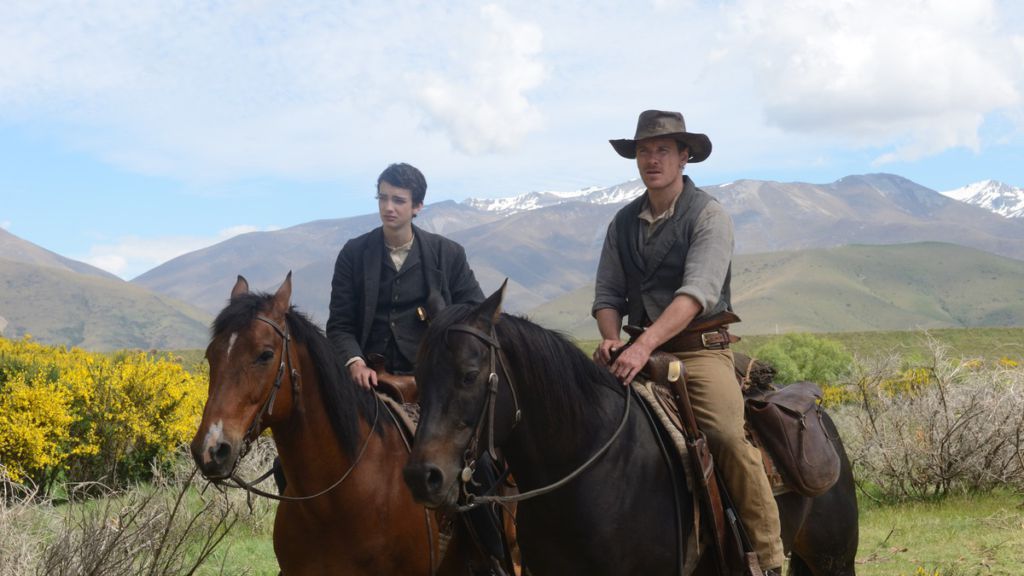
The film centers on a young man, Jay, (Kodi Smit-McPhee) who has traveled from Scotland to the American west in search of his love. He meets a bounty hunter named Silas (Michael Fassbender) who agrees to chaperon him, for a price.

The best I can say about it is that it feels like the neo-western fairy tale lovechild of Shakespeare, the Coens, and Frederico Fellini. It is at times inviting, quirky, sterile, metaphysical, detached, surreal, innocent, and charming. All of that isn't to say that it can simply be boiled down into some weird art movie or that it has no focused tone. Writer-director John Maclean balances all of these disparate elements with a high level of compassionate humanity that helps the story resonate, even as it jars you a little with its next sometimes strange turn.

While Fassbender, as usual, gives us another fine performance, the film really belongs to Kodi Smit-McPhee. He becomes our idealistic (if a little foolhardy) eyes in a West that is without hope or balance. He accepts everything, a kind of non-filter through which we process this new world. And it does feel new. As far as I know, it is the first western to be shot in New Zealand, and it just feels subtly, though pervasively, different from westerns shot here. In that sense it has the same foreign quality as the Italian "spaghetti" westerns, only it has traded their forbidding aridity for high-altitude aspen groves and musings about love.

So I say, go see it. It is a film with an accessibly unique voice, and a welcome change of pace if you suffer from blockbuster fatigue. 

Slow West features Kodi Smit-McPhee, Michael Fassbender, Caren Pistorius and Ben Mendelsohn, and is rated R for gun shooting and some swears. 

Written and directed by John Maclean

Ignore the Wild Wild West-like music in the trailer. Don't worry, it's not in the movie.

25 May 2015

Tomorrowland


Sometimes it is difficult to know to what standard a movie for younger audiences should be held. And make no mistake: Tomorrowland is really a movie for younger audiences. Which I am grateful for. I'm hoping the film sparks a revival in fun live-action movies you could take your kids to without feeling like you're watching a Disney Channel sitcom. In a lot of ways, that is the film's greatest accomplishment. It could very easily have turned into one of Disney's harder-edged PG-13 blockbusters in the spirit of Pirates of the Caribbean or The Lone Ranger, but it didn't. The only trouble is that, while it stuck to its family film guns, it sometimes felt too boiled-down for its lofty premise to support.

Tomorrowland is about Casey, (Britt Robertson) a smart, idealistic girl doing what she can to combat the world's self-destructive side. After she finds a pin that shows her an amazing alternate reality, she decides that the best way to save her world is to go to the other.

I want to note that the film does have a lot of strong points. Chiefest of these is how good it looks. Cinematographer Claudio Miranda's work always looks brilliant, and here is no exception. The design of Tomorrowland itself is also just really cool. It is a fun world to explore, as it should be. The first time Casey explores it, we are treated to the coolest shot of the film: one long, wandering take as she finds her way around the city. The film really sets and maintains a high visual standard for itself.

The other really strong point is Casey herself. She is the kind of grounded, realistic, and positive female character that is usually lacking in films meant for girls to see. We are (really slowly) getting away from this, and she keeps us heading in the right direction.

Most of what doesn't work in the movie comes down to structure. It feels like 100+ minutes of exposition with a second-act climax substituting for the real one rushed through at the end. Don't get me wrong: the forever leading up to actually getting to Tomorrowland is never boring. In some respects it actually has the film's best material. And I guess, depending on how you look at the story, my outline above doesn't really work because during this time Casey is growing and overcoming challenges. But given its setup it feels kind of lopsided. 

My guess is these issues come mostly from the screenplay, specifically from Damon Lindelof's contributions. He seems to do well with big initial concepts that then lack in execution (see Prometheus, Star Trek Into Darkness, and Lost--although, to be fair, these were all co-written as well.) He also has difficulty providing exposition in any other way than by constant questions by characters, which does get super annoying here. Director and co-writer Brad Bird's other scripting work (Iron Giant, The Incredibles, and Ratatouille) tends to be better structured and have less irritating exposition tricks.

Given its issues, the film does maintain a pretty constant, optimistic tone. Some aren't really pleased with this: it feels a little didactic at times, even obnoxious depending on your politics. On the other hand, it encourages us all to be dreamers and to think that something better can happen tomorrow than happened today. Which, considering the cynical, world-wrecking state of our blockbusters, isn't necessarily a bad message to hear.

Tomorrowland features Britt Robertson, George Clooney, Raffey Cassidy and Hugh Laurie, and is rated PG for actiony stuff and some small swears.

Written by Brad Bird and Damon Lindelof
Directed by Brad Bird