29 December 2015

My Top 5 Movies from 2015 (and Also the Worst One)

Well, the end of the year is finally upon us, and that means it's time for me to recap the best of the year so you'll have something to watch instead of Ryan Seacrest on New Years. I have carefully selected my top five favorite films of the year and ranked them according to highly subjective criteria. And to clear things up right away, Star Wars is not on this list, though it made the number six spot. It was narrowly beaten out by...

5. Spectre.
Call this a case of my inner biased James Bond fanboy wanting his own way. This film has received kind of a lot of hate due to its plotting, but one can't really evaluate a Bond based on its plot, because they all have basically the same level of believability. What it does give us is a stylish, dangerous, and appropriately woman-izing spy fantasy that reintroduces the series' most wonderful baddie. Yes, the way he is revealed bugged me, and yes, Sam Smith's "song" is worse than salt and vinegar chips on a canker. But those deficiencies can't defeat my irrational love of these movies, which is, I suppose, what it means to be a fan. I won't judge you if you won't judge me.

4. Macbeth.
This is not your Kenneth Branagh-issue Shakespeare, but it is also not as revisionist as its ultra-stylized visuals suggest. The play is plunged into a period in Scotland where pagan superstition shares the bench with Christianity and bathing is not a concept. Leads Marion Cotillard and Michael Fassbender are a grim delight, and a supporting cast featuring Professor Lupin rounds out a very introspective take on the Bard's grim play. The photography and immaculate composition often evoke a graphic novel-ish aesthetic which is occasionally a little distracting, but it also provides contrasting stimulus during soliloquies that other cinematic adaptations of Shakespeare lack. Check it out.

3. Inside Out.
As the one film on this list that I know all of you have seen, I don't know that I need to say much by way of praise. But I love it as an example of the kind of wonderful thing that can be accomplished in the world of animation, when those in charge are not busy trying to figure out ways to make half a billion dollars on the backs of one-joke side characters. Ahem... Anyway, this film was a delight, somehow maintaining its light heart through some surprisingly complex emotional material that breaks with the black-and-white happily-ever-after doctrine of any mainstream animated feature ever released. (Okay, except Toy Story 3.) And those scenes during the credits, though.

2. Slow West.
Like I have said before, Slow West is the neo-western fairy tale lovechild of Shakespeare, the Coens, and Frederico Fellini, and I loved every minute of it. It is, well, kind of slow, moving between detached scenes in a pretty observational way, but patches of brutish violence or emotional realization punctuate it throughout. Of those on this list, this is the film you probably have heard the least about, so I highly suggest going and renting it, like tonight. It is the kind of unexpected delight you only get a few of each year, and in another year would have been sitting at the top of this list. But what could possibly have topped such a wonderful little thing?

1. Mad Max: Fury Road, duh.
I want to be careful not to wax too hyperbolic here, but  Mad Max: Fury Road is as close to a perfect a movie as they come. It is, first of all, an absolute riot: an exhilarating, crazy, technically exquisite thrill ride. It also functions as the best, most concise symbol of the terror of the unbridled masculinism in our culture. It is the perfect marriage of pure cinematic showmanship and timely, uncompromising, but undidactic commentary on what we live with today. It is the result of of years of work by masters at the top of their game, visual storytelling the way it ought to be. And if you don't like it, our relationship may never recover. There, I said it.

This brings us to the real reason you're reading, to find out what I really didn't like. So here we go:

Jurassic World

My issues with this movie are many and varied, but let's start off by saying that it just wasn't good, like in any way. There is not much to be entertained by in terms of character, plot, or action. In fact, it leaves mostly a bad taste in the mouth due to its bizarre sexism and constant "hey, remember this?" moments. I say that it is worse than what you think of as other "bad" movies because it is so intent on being as good and important as its older brother, and is so inexplicably popular. Bad movies usually have the decency to at least not make money.

It is what others more clever than I have termed a "legacy-quel:" a narratively unnecessary sequel that relies more upon nostalgia than novelty in order to bring in an audience. Here we see recycled fan-favorite sets, props, and animated characters that make us think of watching Jurassic Park on VHS after school. These winky moments trick us into thinking we like the movie, when really there are no likable characters or memorable sequences, only lots of cartoon dinosaurs and product placement. Other legacy-quels of note this year include Terminator: Genisys and, yes, Star Wars. Almost all of Star Wars. But what about Mad Max, you say. It is not, since it does not pander for attention by throwing in references to Bartertown or Toecutter. It supplies new material with the tools provided by its world. A fine line, but one that Jurassic World crosses repeatedly and unenjoyably.

But with all of the cinematic good out there, we needn't bother with the rubbish. And you needn't even bother with the rantings of this writer, for if you have enjoyed any movie, that ought to be good enough, and I can and should have nothing to say against it. Just please enjoy movies next year responsibly.

21 December 2015

Star Wars: Episode VII - The Force Awakens


There's no need to address the hype or response to this film, so let's just jump right in. Be advised that this will be a candid discussion you might not want to participate in if you haven't seen the film.

First, I say that The Force Awakens is a good movie. It is fun and exciting and pretty much what you would hope for. I think it strikes the right kind of tonal note for fans of pretty much any level of intensity, and may even encourage a different stylistic approach to large fantasy tentpoles, which I'd be just fine with.

I say that because the film's greatest strength is its wonderful design. There is just something lovely about real props and creatures and robots and stuff in a movie like this. Even if you know it's just a guy in suit or an overlarge puppet. I don't know that any one thing could have tied this movie to its ancestors better than this kind of stylistic approach. Using sub-par 21st century CG visual effects is one large reason why movies like Indiana Jones and the Kingdom of the Crystal Skull and Terminator: Genisys are no where near as cool as what came before. That, and, well, crappy storytelling. But whatever.

All of this practical design makes for an unartificially fun viewing experience, which is what a movie like this should be first and foremost. Adding to that fun is the delightful dialog by master Lawrence Kasdan. He gets playful intergender banter like no one else in the business. Where lesser writers opt for casual misogyny or unfounded competition, he goes for good-natured, witty word sparring. He is also the reason geriatric Han Solo works, which was my single greatest fear going in. So wherever this film works, thank the design team and Mr Kasdan.

And of course, Daisy Ridley. I mean seriously.

Now, although I have said it is a good movie, it is not a really good movie. One mustn't confuse exhilaration leaving the theatre for witnessing a marvel. For, as delightful as many of its elements are, the movie suffers from one kind of large problem: it's not really very complete. It functions like a really fun first act. Which, you say, it is, since it's a trilogy. But I think that it still ought to be complete in itself, with more complete character arcs and resolutions. Instead I almost get the feeling of being played, of being put off until the real movie comes out in a few years and then the world explodes out of its wonderfulness. But what else could we expect from the people who bring us a certain other "cinematic universe."

I don't want to sound like a whiner, but I really think we should at least consider the film's structural issues while heaping praise upon it. Because of how it is structured, none of the characters really have any significant development, and therefore problems kind of just solve themselves, leaving the characters essentially where they were. Take Rey. She starts off as determined and competent, and she stays that way. The one difference is that she can Force by the end, something that took Luke two masters and three movies to do but which she teaches herself in an afternoon to get out of a plot corner. The effect this change has on her as a character is not seen. It is perhaps hinted at in her journey to Luke, but something that momentous should be concluded better. Meanwhile, no other character is given any kind of resolution, either, or even time to process or emote about the death of the series' most beloved character. I guess we'll just have to wait until next time.

Of course you'll say that The Empire Strikes Back ends like that, too. Which it does. But it is the middle chapter, not the first. With it, we have already been through like five hours of story together, seen growth, setback, triumph, and failure, and know the characters well. I do not think we know any of our new characters well enough at the end of The Force Awakens or have seen them do enough to leave them as we do. It may end up being a gutsy, satisfying way of structuring the new trilogy. But until it can be enjoyed as a whole several years from now, it is an incomplete and narratively weak chunk of story.

So I say go and see it and enjoy the heck out of it, because it is an undeniably fun ride. Its enjoyability largely outweighs its dubious structure (which will be forgotten once everyone owns all three anyway) but that does keep it from being great.

Star Wars: Episode VII - The Force Awakens features Daisy Ridley, John Boyega, Oscar Isaacs, Domhnall Gleeson, and all your old favorites, and is rated PG-13 for general Star Warsing.

Written by Lawrence Kasdan, JJ Abrams, and Michael Arndt
Directed by JJ Abrams

11 November 2015

Spectre

Movies in the James Bond genre are an interesting breed. And don't get me wrong, they are their own genre, one that has managed to exist for over 50 years now. I recently rewatched the entire collection, and something occurred to me: most of them are not all that good. Plot-wise, they are all basically the same. There are notable characters or sets or music, but they are very often essentially the same movie. But, if you are a fan there is no real problem with this. You watch them to experience your inner playboy English gentleman.

Enter Spectre. It is a movie which does little to subvert expectations or plumb new depth in the way that the series has attempted since Daniel Craig's ascension to the role. Some have argued that it is the worst of his entries for that reason, especially since it seems to claim to do otherwise. But I am not so sure. It may well turn out to be that, but I am hopeful that time will prove otherwise.

Let us now speak frankly of the plot, or at least a part of it. I am at once happy to see the return of Blofeld, and a little disappointed. I am disappointed because the filmmakers pulled a Star Trek Into Darkness on us by pretending he wasn't Blofeld until it was time for a dramatic reveal. The trouble with this gimmick is that it only works on fans of the movies, in this case, movies that are now more than 40 years old. The change of character name (as with Into Darkness) means nothing unless you are. So it is an unfortunate, self-aware fanboy concession that adds only sentimental value.

But, I am happy because it now opens up wonderful possibilities for the future. The films have lasted so long in part because of their nondependence on each other for continuity. Each is (for the most part) its own separate episode. Blofeld is far and away the most iconic and sinister Bond villain, as well as the only recurring one. I also like how personally connected to Bond he now is. Now Spectre leaves me thinking that perhaps this pattern will be broken, and that the film will be something like the first of two parts. Which makes me feel mostly okay about the relative incompleteness of plot and emotional resonance with a 160-minute film.

I say mostly because Spectre, considered on its own, is fairly mundane. The action meets the series' high standard, but the emotional side of Bond explored of late is pretty muted. The plotting (as with them all) is a little silly at times, but the concern over surveillance and its misuse by desk jockeys feels at least timely, if a little unoriginal. I also tend to hate the kind of wait-til-next-time-for-the-real-story world building so many franchises are now guilty of, and one thinks that this film is that kind of link in the chain. It is enjoyable, manages something of a light heart, and is certainly better than anything else out this week at the multiplex.

But such it is to be a fan of a film series: quick to forgive so long as there will be more to come. As long as whatever comes doesn't include Sam Smith.

Spectre features Daniel Craig, Christoph Waltz, Léa Seydoux, Naomie Harris, and Ralph Fiennes, and is rated PG-13 for general Bonding throughout.

Written by John Logan, Neal Purvis, Robert Wade, and Jez Butterworth
Directed by Sam Mendes

02 October 2015

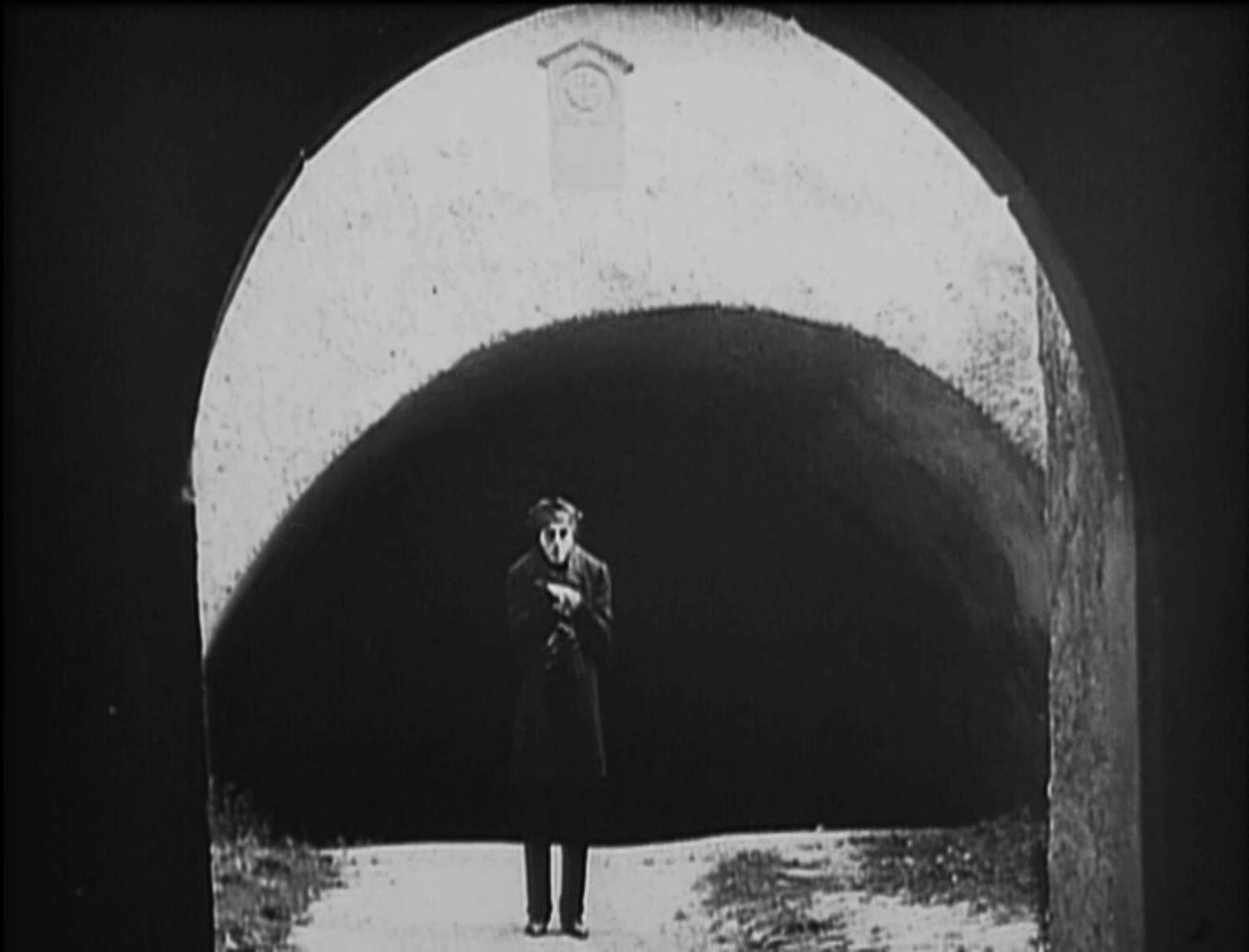
Octobooooo-er Special: Nosferatu

Max Schreck as the titular bloodsucker
We have now come to that most wonderful of seasons, the October season. And to celebrate, I am going to present a series concentrating on spinetingly-dingly films for your enjoyment. The first of these is one of the great achievements of the silent era, FW Murnau's Nosferatu: A Symphony of Horror.

Taken together with 1920's The Cabinet of Dr Caligari, Nosferatu (1922) forms the foundation upon which all horror cinema builds. (And indeed, the two pair excellently as a double feature.) Like Dr Caligari, it comes out of the German expressionist tradition. The film retells in an unauthorized, folklorey kind of way Bram Stoker's tale of Dracula, which I hope I don't have to summarize for you

The film's most striking feature is its iconic imagery. You have seen the shadow of Nosferatu's taloned hand reaching for his victim; his pale, pointy face in reverse silhouette against the dark. You know what he looks like as he rises from his coffin and as he moves up the stairs. These and other images from the film have been reproduced, parodied, and referenced to one degree or another in almost any horror film you have ever seen. Much more than its cousin Dr Caligari (which sets the par for striking imagery) Nosferatu has remained an essential element of our cultural subconscious. I think this is  in part due to the fact that, although undeniably expressionist, the film's real locations (instead of cubist, abstract sets) ground it in a kind of reality that the fever dream of Dr Caligari doesn't reach for. It feels just off-center instead of nearly hallucinogenic.

The other element that takes the film a step beyond Dr Caligari and maintains its amazing influence is its pioneering achievement in editing. Some of its best moments are when it intercuts between the vampire's ship and the separated lovers he threatens. These truncated pieces balance wonderfully with the long, methodical takes that dominate whenever Nosferatu is present to create an agonizingly fatal kind of mood. He is as inevitable as the tide, an ever-present theme in this silent symphony.

Lest I inadvertently plant expectations that won't be met, I should note that in establishing the genre, the film differs quite substantially from our modern horror sensibilities. In fact, I would say that it likely won't "scare" you like you're used to. There are no "jump" moments or even attempts at irony or mystery. What you will find instead is a slow, constant, fully-realized single image, which, as a film, you have as little control over as our heroes do their fate. You and they can both only watch, and hope for a good end.

I should also note that many versions of Nosferatu can be found for free on the internets, and that probably none of them are very good. Film scans used are often incomplete or of poor quality, and the music can either have nothing to do with the film or just be really bad. I recommend finding a proper DVD release, which are usually done by some manner of film preservation society. Their scans are as good as can be found, and the music is usually at least not bad. If you prefer, though, watching it with no music at all is especially ambiential and creepy if you are alone in your room at 11 at night and it is raining. Just saying.

So I say you really should see Nosferatu. It is certainly a great way to start off your October season, and is as foundational and influential to the horror genre as anything out there.

Nosferatu: A Symphony of Horror features Max Schreck, Gustov von Wangenheim, Alexander Granach, and Greta Schroeder, and is unrated, though appropriate for most audiences.

Written by Henrik Galeen
Directed by FW Murnau

Fan-made trailers, like full copies of this film found online, vary greatly in quality. I suggest watching this with the sound muted, because the music is beyond obnoxious. But it gives a glimpse of the images, as well as the color-tinted filmstock some restorations use.


21 September 2015

The Visit

Over the river and a through the weird, to Grandmother's house we go.
Well, I'm back (not that you were upset) just in time for fall. I won't hesitate in saying that the summer cinematic season was a little less than exciting for me, but there are a few I'm looking forward to starting now. The first of these, just in time for fall, is M. Night Shyamalan's The Visit. It is his most stylistically sincere film in many moons, although how you feel about it will depend on how much strange you like in your diet.

The film is about Becca and Tyler, tweenaged siblings who go for a week's family bonding with their estranged grandparents. Weird old people problems become gradually less shrug-offable as the week wears on as Becca sifts through the footage to help bring the family back together.

First, I'll address what you've probably heard, that this film is a refreshing return to form for Shyamalan. This is mostly incorrect. True, the film provides jumps and tension, and it also showcases his humor more than any of his work since probably Signs, and is not bad. However, the director's subtler (and more defining) stylistic hallmarks are not present. There is no carefully-meditated cinematography, no spiritual undertone, no introspective current. The film feels, more than anything else, like a stretching of creative arms after increasing studio oversight and critical derision, coupled with the producing talents of the people who brought you Insidious.

So let's talk about the film we have. I said it was stylistically sincere, and that style takes the form of a documentary shot by our protagonists. It is not "found-footage," but is only just barely more cinematic. The location is beautiful and the establishing shots wonderfully composed, but much of the action is composed of blurry, jittery footage that would likely not have made it into Becca's documentary. Not that it doesn't work. But even under the guise of "documentary style," it is a form that demands constant attention to and justification of itself, which adds an unnecessary layer of distance between the audience and an otherwise tense story. It is, in the end, the film's greatest weakness.

But I'm not sure how I feel about the rest of it. I left feeling mostly unsettled, but not in the way that "disturbing images" alone make you. It was more the complete unconnectedness of the film's elements. The music is a stringy, sentimental, and oddly funny tune from an old musical. Tyler (aged 13) has not one but three freestyle whiteboy raps that were embarrassing to watch with other people. And of course, the photography swings between unsettlingly static and uncomfortably immediate.

One gets the sense that Shyamalan is winking at his audience, delighting in the almost self-consciously bizarre spectacle they have admitted themselves to. And in that sense it is one of his stronger artistic statements for a long time. But upon reflection upon the film's assembly and tone, one also gets the sense of how the strange grandparents in this tale might feel, confused, without good bearing, but intrigued. So it works. My one story qualm is fairly minor, but worth mentioning. I felt a little disappointed when the film's main thematic takeaway was a hamfisted exhortation to not hold onto anger, instead of at least acknowledging the weirdness and disconnect inherent in the millennial habit of pointing a camera at anything in order to come to some sort of catharsis, even if it might kill you. Maybe next time, though.

The Visit features Olivia DeJonge, Ed Oxenbould, Deanna Dunagen, and Peter McRobbie, and is rated PG-13 for many things grandparents don't usually do and some swearsing.

Written and directed by M. Night Shyamalan.